I am particularly interested in multi-disciplinary climate change fields. My research topics aim to understand the role of water and the associated hydrological processes in regulating global environmental changes in the present and future. While much of my research focuses on the physical mechanisms in climate extremes, e.g., extreme precipitation, heatwaves, floods, and wildfires, I am also interested in how these extremes affect the ecology, human, and socioeconomic systems.
Besides the traditional analyzing methods, I am very enthusiastic about using the knowledge of artificial intelligence approaches to comprehend the causes and consequences of these hydrological extremes. My research topics are summarized as followed.
Impacts of Climate Change and ENSO variabilities on Snow droughts in Asian Water Tower
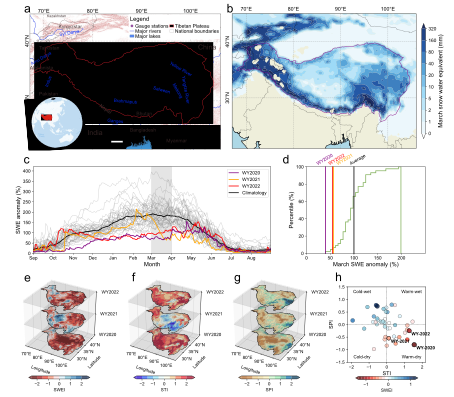
The Tibetan Plateau has experienced increasingly unprecedented snow droughts under climate warming, raising concerns about regional ecosystem sustainability and water resource security. While warming and drying are primary drivers, the specific roles of anthropogenic warming and climate variability in affecting these drivers and, consequently, the occurrence of snow drought remain unknown. In this study, we incorporated multi-source snowpack data and leveraged climate simulations to provide a detailed analysis of snow drought occurrence and trends across the TP. Our results provide critical insights into the driving mechanisms of snow droughts in this climate-sensitive region, aiming to support decision-makers in advancing climate resilience and sustainable water management. (Under review)
Fig 1. Snow drought characteristics in TP.
Investigation of the Evolution Characteristics and Physical Processes Driving Dry and Wet Heatwaves in South China
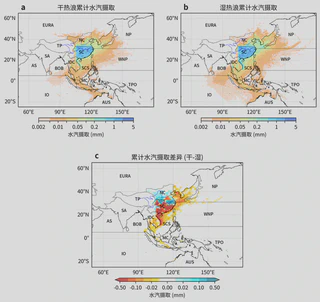
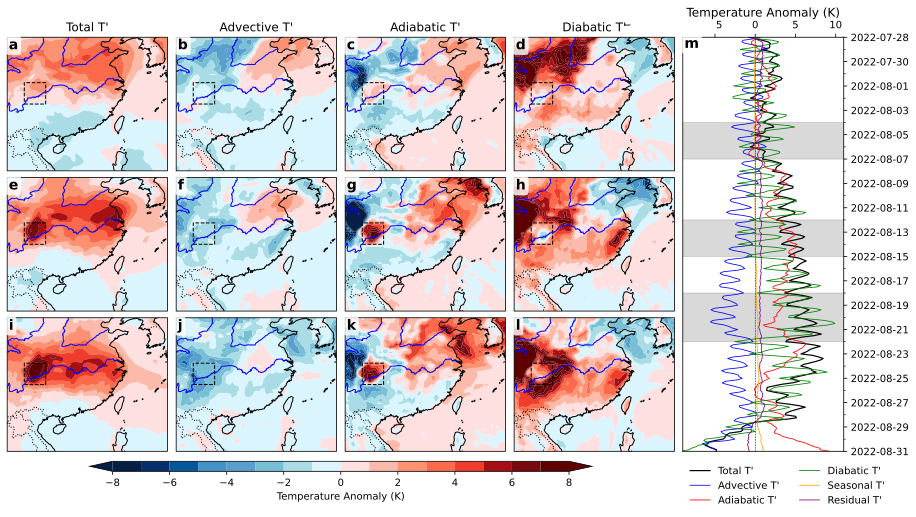
In the context of global warming, the growing frequency of heatwaves poses significant risks to agriculture production, water resource management, and public health. While previous studies have primarily relied on composite analyses of background atmospheric circulation to characterize dry and wet heatwaves, they provide limited insight into the underlying physical processes. Meanwhile, the sources and transport of heat and moisture in heatwave dynamics remain unresolved. Here, we applied Lagrangian backward tracking and heat budget decompositions to provide a complete picture of source regions, typical transport patterns, and physical processes in the air masses for different temperature extremes.
Fig 2. Comparion of the spatial distributions of daily accumulated moisture uptake associated with historical grid-based dry and wet heatwaves.
Fig 3. Temperature anomaly decomposition for the 2022 dry heatwave.
Relative Contributions of Large‐Scale Atmospheric Circulation Dynamics and Anthropogenic Warming to the Unprecedented 2022 Yangtze River Basin Heatwave
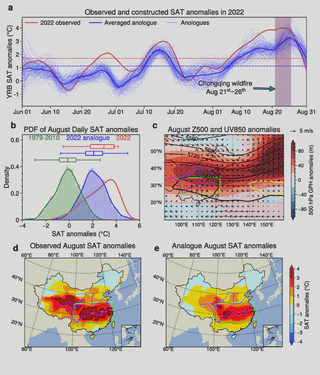
The unprecedented 2022 Yangtze River Basin (YRB) heatwave is a threat to human society and natural ecology, so the understanding of its underlying drivers is critical to regional climate adaptation and resilience. Here we conducted a multi‐method attribution analysis on the contribution of atmospheric circulation change and anthropogenic impacts to the occurrence probability and intensity of this extreme heatwave. Based on the nonstationary statistical analysis, the 2022 YRB heatwave is a 1‐in‐900‐year event and a 1‐in‐110‐year event with and without considering the 2022 YRB heatwave in the fitting, respectively. The large‐scale meteorological condition analysis shows that the 2022 YRB heatwave is featured with an anomalous highpressure system that favors a hot and dry atmospheric column, overlaid by anomalous subsidence and clear skies which leads to warming and greater solar heating. The ensemble constructed circulation analogue analyses show that the circulation anomaly fails to explain the observed 2022 YRB SAT anomalies fully. Specifically, 46% (0.132 ± 0.027°C decade 1) of the observed SAT trend during 1979–2022 (0.290 ± 0.048°C decade 1) is caused by anthropogenic warming and the associated thermodynamic feedback, while the remaining 54% (0.157 ± 0.038°C decade 1) of the trend is caused by changes in the large‐scale atmospheric circulation. Our findings on changes in atmospheric circulation patterns associated with YRB heatwave and anthropogenic contributions to YRB heatwave could provide valuable information for climate adaptation and mitigation strategies in the context of a warming climate.
Fig 4. The relative contribution of large‐scale atmospheric circulation dynamics and anthropogenic warming to the 2022 Yangtze River Basin (YRB) heatwave.
Future Directions
Looking ahead, my research will focus on:
Multi-model ensemble approaches for better uncertainty quantification
High-resolution climate modeling at regional scales
Interdisciplinary collaborations bridging climate science and policy